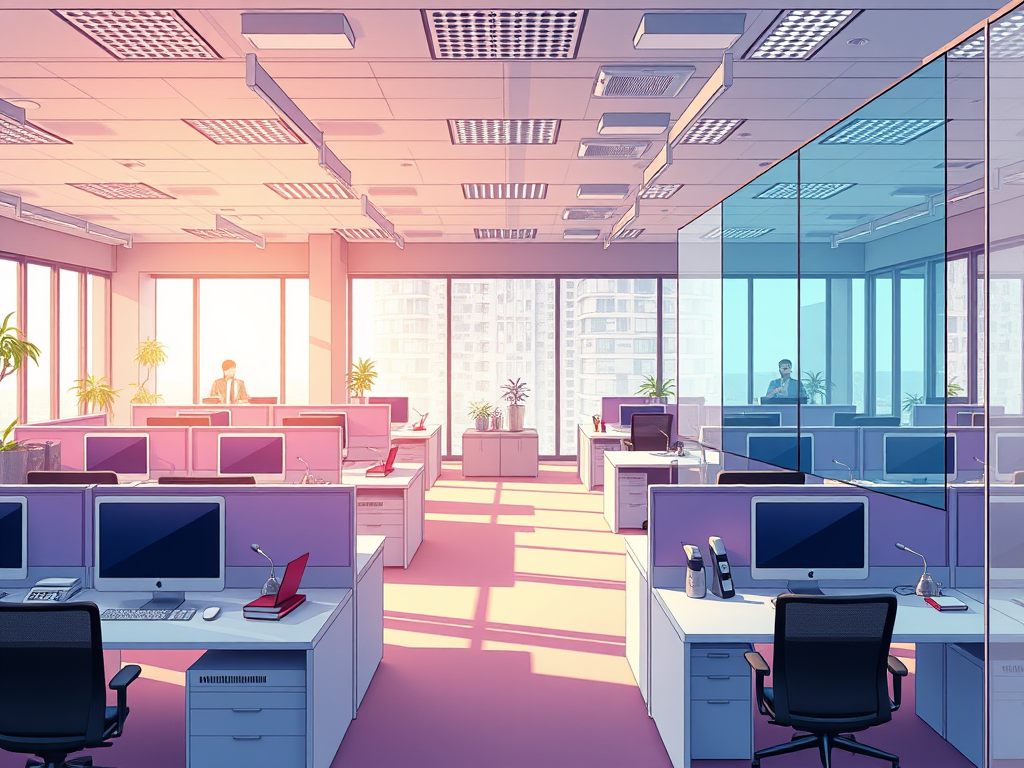
Geopolitics is defined as the study of the influence of geography on international politics. It evaluates how the location of a territory and its demography of impact its relation with the rest of the world, starting with its neighbours.
In the scale of large organizations, a new science ought to be born: Deskology, the study of an employee’s desk location and its influence on their career, and on their relationships inside the firm.
Deskology had quite an evolution, from the individual cubicles to the office space, and from lavish offices with full on varnished oak furniture to minimal design and transparent glasses offices.
It almost had a near death moment due to Covid.
The pandemic was thought to make this science obsolete, but it’s back on due the massive effort to bring everyone back to the office. Covid led to hybrid deskology though, an even more complex branch of office geopolitics.
So why are office geopolitics of the utmost importance?
While a lot of professions with no desk – gardeners, doctors, firemen- would find it hard to grasp the importance of such a thing, everyone who worked in an office knows how crucial it is to have the right desk location.
Being next to the office gossip? Great to learn who’s backstabbing who. Being next to the boss’ office? Awesome to know the right time to pop in for an impromptu meeting where you can advance your ideas. Being next to the manager’s desk, ideal to build a critical relationship. Sitting strategically in the middle of the team, tactical to be seen as a collaborative team worker.
And that’s the cynical ruthless view of deskology.
Anyone who has worked in large institutions for over a year had at least gone through an office space relocation. Does anyone remember getting the email which “consults” on desk allocations? Anyone familiar with the critical problem of being on the corner or being near the passageway?
Has anyone been to a team meeting with the agenda item “Discuss seating plan”? Did anyone negotiate being next to the data terminal or far from the printer?
And more recently, in the time of working from home and hybrid work, anyone familiar with the tactics of getting a strategic desk when no desk is allocated and all are up for grabs? Tip: most successful tactic is arriving at the office very early.
It might seem petty and exaggerated, but there are indeed some rules to stick to in terms of office space location.
These rules are not very far away from actual geopolitics rules.
Rule number one would be to avoid sitting by any door if you can.
Rule number two is: if you choose where to sit, that location will make more sense for your job than if someone else decides for you.
Rule number three: think carefully about the balance between being closer to your boss, and being closer to the people who work for you and with you.
Pragmatically, from a health and well-being side, having access to some real light from a window can significantly improve a working experience. So does avoiding being directly below the air conditioning, or spending the day listening to your neighbour’s incessant zooms.
And being in the middle, or close to the key managers, can make a large difference to a career.
And let’s not get started on how sitting close to the toilets or the sliding door can make an impact on one’s lived work experience.
I wondered if there was research or studies on this, so I googled “is where you sit in an office important”. I found more articles and assessments on this than I thought I would, including machine learning behavioural analysis on working space.
I am sharing here some summaries and takeaways.
Apparently what I called deskology is called “Spatial management”. One article [1] cites a study which concluded that “seating the right types of workers together led to increased productivity and profits. [and that] If you sit a strong and a weak performer next to each other, the weaker employee performs much better, and the stronger employee’s performance doesn’t decline much at all”
Another article found on LinkedIn [2] refers to a UCL paper called “‘Differential Perceptions of Teamwork, Focused Work and Perceived Productivity as an Effect of Desk Characteristics Within a Workplace Layout’ “. In this research [3], authors examined the UK HQ of a large international technology company. They surveyed a large number of staff through a questionnaire aiming to assess productivity, job satisfaction, well being and efficacy. The questions also sought to validate the authors’ hypothesis about what would make a location a prized one.
They found no link between desk centrality or proximity to other desks and a worker’s ability to reach their team. And they validated their hypothesis that window seats enhance productivity and focus.
Their main two findings however showed that the key spatial metrics were: i) how many desks were in the line of sight of the staff member; ii) how much someone’s back was protected.
The fewer desks in someone’s vision and sight, the better the ability to do focused work but also surprisingly, the more teamwork was highly rated. And the more activity happening on someone’s back, the more the employee or the team did not view itself as within a cohesive environment. To quote the paper: “having many colleagues’ in direct sight and plenty of activities going on behind someone’s back […] was not viewed as favourable as being in smaller, more easily controllable areas”.
I was a bit surprised by this result, mainly due to my own experiences.
When I had a desk that faced many of my colleagues, I found it easier to connect with them. It saved me the need of setting up formal meetings, as I knew when they were available. And I also found they reached out to me more easily/frequently than when I had wall or corner desks.
I had also thought that, for senior employees at least, it was beneficial to be easily reachable.
Deskology is a complex science but from the sheer size of research that was done on it, it would be a mistake to not factor it in leadership discussions. This is compounded by the new hybrid working complexity of no fixed desks in some departments or institutions.
Familiar stories about desk politics include considerations not only on location, but also size (in square meters and ego units both). I was told an anecdote of a head of a risk management department who, upon his promotion to senior executive, insisted to have an office the size (in square meters to the dot) similar to that of the trader who was at the same level as him. Apparently, he allocated budget to that effect and literally got the company to get rid of a few desks to build him an office.
How that got signed off, I cannot fathom, but I have myself seen similar behavior in another context where a newly promoted executive refused to use any furniture used by his predecessor.
Deskology can also reflect forms of non-inclusion if not discrimination. There were many examples I observed when managers surrounded themselves with their buddies, and isolated team members they liked less on a personal level.
It can also be a way to analyse the importance of teams and whether it is a fair reflection of those teams’ contributions. Are the trading desks systematically in the best floors? is IT and desk support relegated to a room with no windows? Are assistants often relegated in forgotten rows? And can we blame some staff who would prefer to work from home, given where their desk would be in the office?
In the time of desk sharing, it is important to remember that a desk is not only a convenient place to conduct one’s work, but a space where valuable time is spent. It has a strategic value which should be understood,
Sources:
[1] How Where You Sit In Your Office Impacts Your Productivity – Fast Company
[2] The Office – It matters where you sit…
Disclaimers can be found here.




 A WOMAN IN THE CITY